
Research by Transparency International Turkey Finds UN Global Compact Companies Outperform Peers on Anti-Corruption and Transparency Reporting
Read more
Istanbul, Türkiye
The following is an article submitted by a Global Compact Local Network. Please contact the network representative listed below with any questions regarding its contents.
(Istanbul, 19 March 2015) – According to research conducted by Transparency International Turkey (TI-Turkey) – as part its “Multi-Stakeholder Approach for Transparency in Corporate Reporting” project – publicly-listed UN Global Compact companies in Turkey outperformed their peers in terms of transparency reporting on anti-corruption programmes.
TI-Turkey analyzed the corporate reporting practices of Turkey’s 100 largest publicly-listed companies in the Borsa İstanbul (BIST)-100 Index, 13 of which were UN Global Compact participants. The scope of the data review and assessment focused on three main areas:
- Reporting on Anti-Corruption Programmes: Anti-corruption programmes include corporate policies and procedures implemented by companies in line with their defined principles and values to prevent corruption both in own internal functioning and in relations with their stakeholders. The existence and scope of such a programme as a corporate roadmap of combating corruption is important to demonstrate corporate awareness and resoluteness. The study included 13 questions inquiring the extent of information disclosed by companies on their anti-corruption programmes.
- Organizational Transparency: The questions on organisational transparency intended to assess the information disclosed in their consolidated financial statements on related entities such as subsidiaries, affiliates or joint ventures, and the countries of incorporation and countries of operation of such related entities. This section is important to hold the parent company accountable not only for itself but also its related entities and enhance accountability. The section included 8 questions in total.
- Country-by-Country Reporting: Country-by-country reporting is a mode of reporting on the basis of individual countries where the reporting company discloses key financial data including primarily the revenues earned and taxes paid through their subsidiaries, affiliates or directly owned branches established abroad. Country-by-country reporting is a means to hold companies accountable not only to the local community of the countries of incorporation (where the headquarters is located), but also to that of the countries of operation. This section included 5 questions in total.
While the study revealed that Turkish companies within this index performed much lower in terms of the transparently reporting on anti-corruption programmes compared to similar studies in other emerging markets, the 13 UN Global Compact companies in the index performed higher within the BIST-100 index overall.
Olajobi Makinwa, Head of Transparency and Anti-Corruption at the UN Global Compact noted, “The business case for fighting corruption is increasingly getting stronger. We have witnessed how companies and other stakeholders have started taking a firm position against corruption by setting robust policies and practices that can decrease the related risks and increase a company’s appeal to investors and consumers’’.
Comprehensive and transparent corporate reporting on anti-corruption programmes is a strong indicator that a company has an awareness and willingness to act against corruption. Although transparent corporate reporting does not assure that the company refrains from corrupt practices, it demonstrates the company’s commitment and serves as an effective tool for risk assessment with regards to corruption.
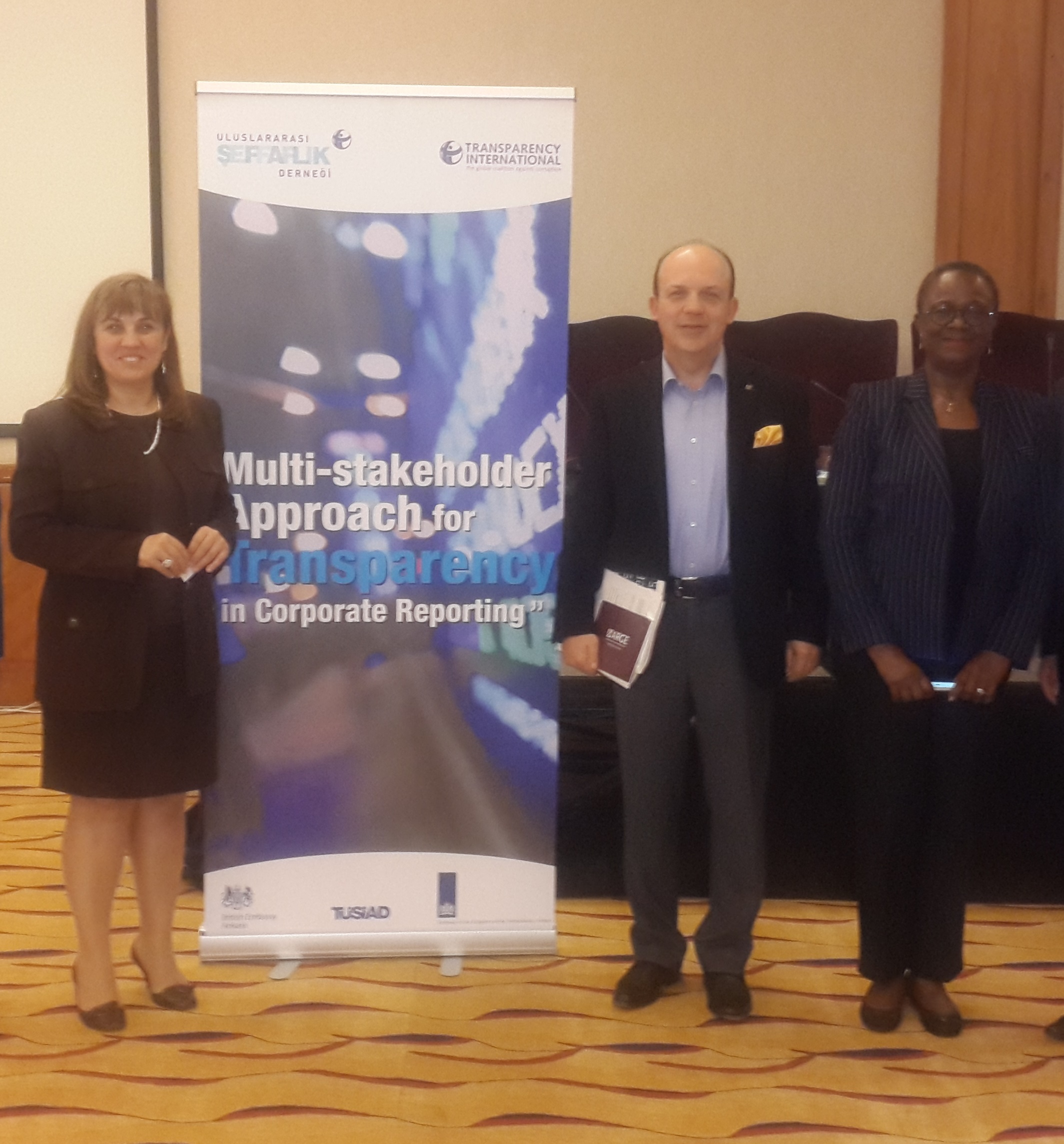
Oya Ozarslan, Esq., Chairman of TI-Turkey remarked, “The role of the private sector in prevention of corruption is being regarded as a crucial factor. TI-Turkey encourages a multi-stakeholder approach and public-private cooperation towards greater transparency and to stimulate change among the business community to lead the fight against corruption in Turkey’’.
“The result of this research, the first of its kind in Turkey, stipulates that publicly listed companies that took part in the survey that are participants of the UN Global Compact out-performed their peers,” said Dr. Yilmaz Argüden, Chairman of the Board and Network Representative of Global Compact Network Turkey. “This reaffirms our fundamental belief that the 10th Principle of the UN Global Compact provides a policy framework, and with the support of vital tools and resources such as the reporting guidelines, companies can continue to ensure the long-term wellbeing of their company and reputation and increase shareholder value''.
The Project was led and implemented by TI-Turkey and supported by the British Embassy’s Prosperity Fund and the Dutch Embassy’s Matra Program in partnership with TÜSIAD.
- Read and download the report, Transparency in Corporate Reporting
- Learn more about Global Compact Network Turkey
About Transparency International Turkey
Founded in 2008 by voluntary efforts, Transparency International Turkey is a fully accredited chapter of Transparency International. Having adopted Transparency International’s vision, mission and core values, TI Turkey aims to set the rule of transparency, integrity and accountability principles in all segments of society for the democratic and economic development of Turkey, and carries out research, campaigns and projects in various fields, such as the public and private sectors and the media. For more information, visit:http://www.seffaflik.org
Contacts
Transparency-International Turkey
Emre Dönmez
Researcher, Transparency International Turkey
e.donmez@seffaflik.org
+90 212 240 52 81
www.seffaflik.org
www.transparency.org
Global Compact Network Turkey
Deniz Ozturk
Advisor to the Board
Global Compact Network Turkey
dozturk@globalcompactturkiye.org