
Business leaders join UN Secretary-General, Heads of State and young entrepreneurs to tackle climate crisis
Read more
New York, United States of America
UNITED NATIONS, New York, 23 September 2019 — More than 150 Chief Executives from the world’s leading businesses joined Heads of State and Governments, young entrepreneurs, and leaders from both the United Nations and civil society today at the UN Secretary-General’s landmark Climate Action Summit.
Working together to keep global temperature rise below 1.5˚C and to ensure a just transition to a net-zero future by 2050 were the major topics of discussion at a series of events organized by the UN Global Compact during the 74th regular session of the UN General Assembly.
The Private Sector Forum — the official luncheon of the Climate Action Summit — brought together more than 350 global climate leaders for a multi-stakeholder, intergenerational dialogue designed to help the world urgently align on a collective course of action in tackling the climate crisis. The Forum also provided a platform to recognize the Chief Executives of 87 companies that had stepped up their climate ambitions by committing to set 1.5˚C-aligned science-based emission reduction targets through the Business Ambition for 1.5˚C — Our Only Future campaign.
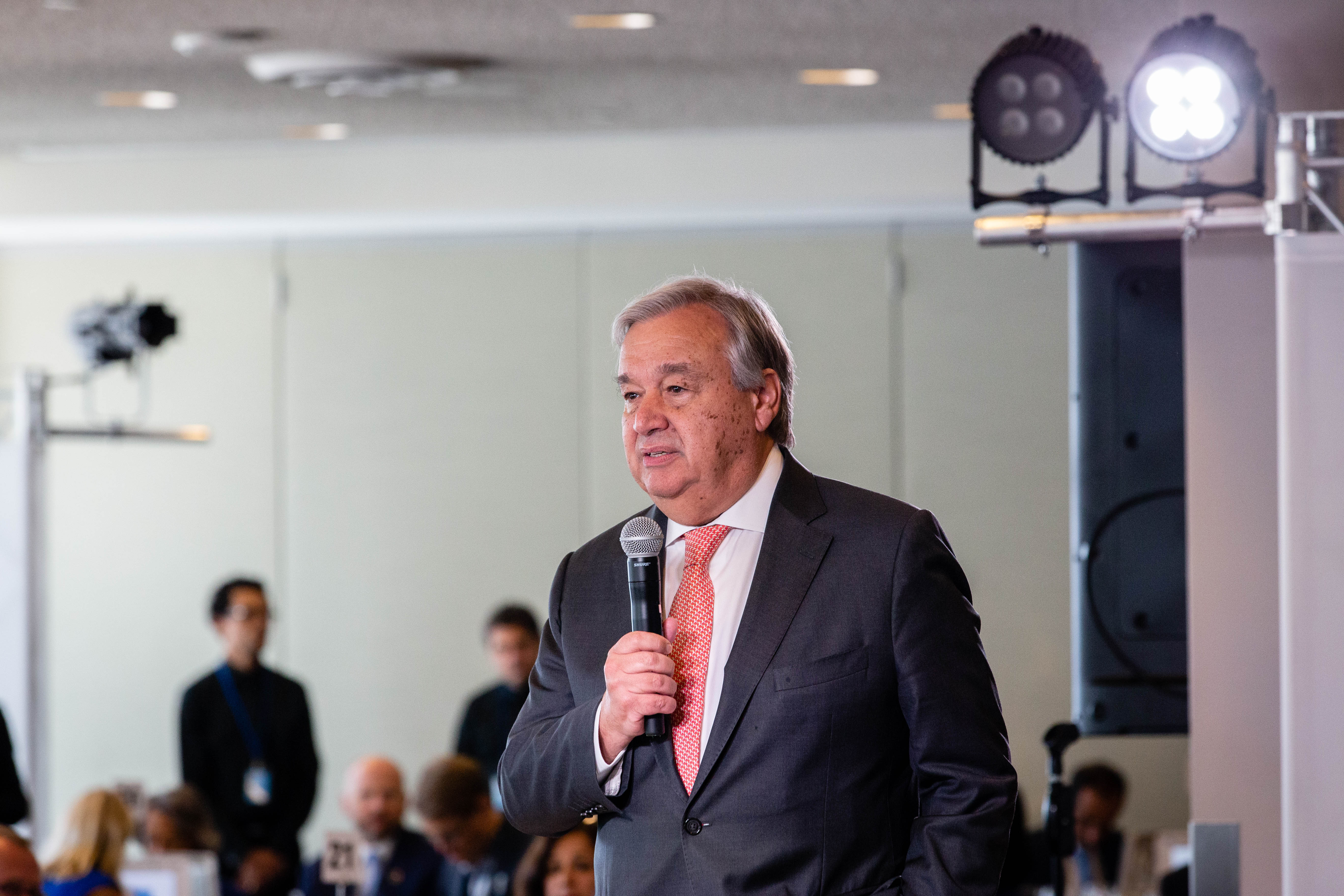
United Nations Secretary-General António Guterres at the Private Sector Forum 2019.
Photo credit: UN Global Compact/Joel Sheakoski
Speaking at the Forum, UN Secretary-General António Guterres emphasized the critical role that businesses play in challenging Governments to be accountable for enacting climate action plans aligned with a net-zero future, saying, “My appeal to all of you is not only to have a very strong commitment to the green economy, not only to bet on a carbon-neutral future for your businesses, but also to use your leverage in relation to Governments and to explain to them that it is much better to tax carbon than to tax income.”
“The point is not that we need to put into question the market economy to achieve a green future. The point is that we need to abolish distortions of the market economy and [instead] create incentives for normalcy to happen, which is needed for the green future to effectively happen,” added Mr. Guterres.
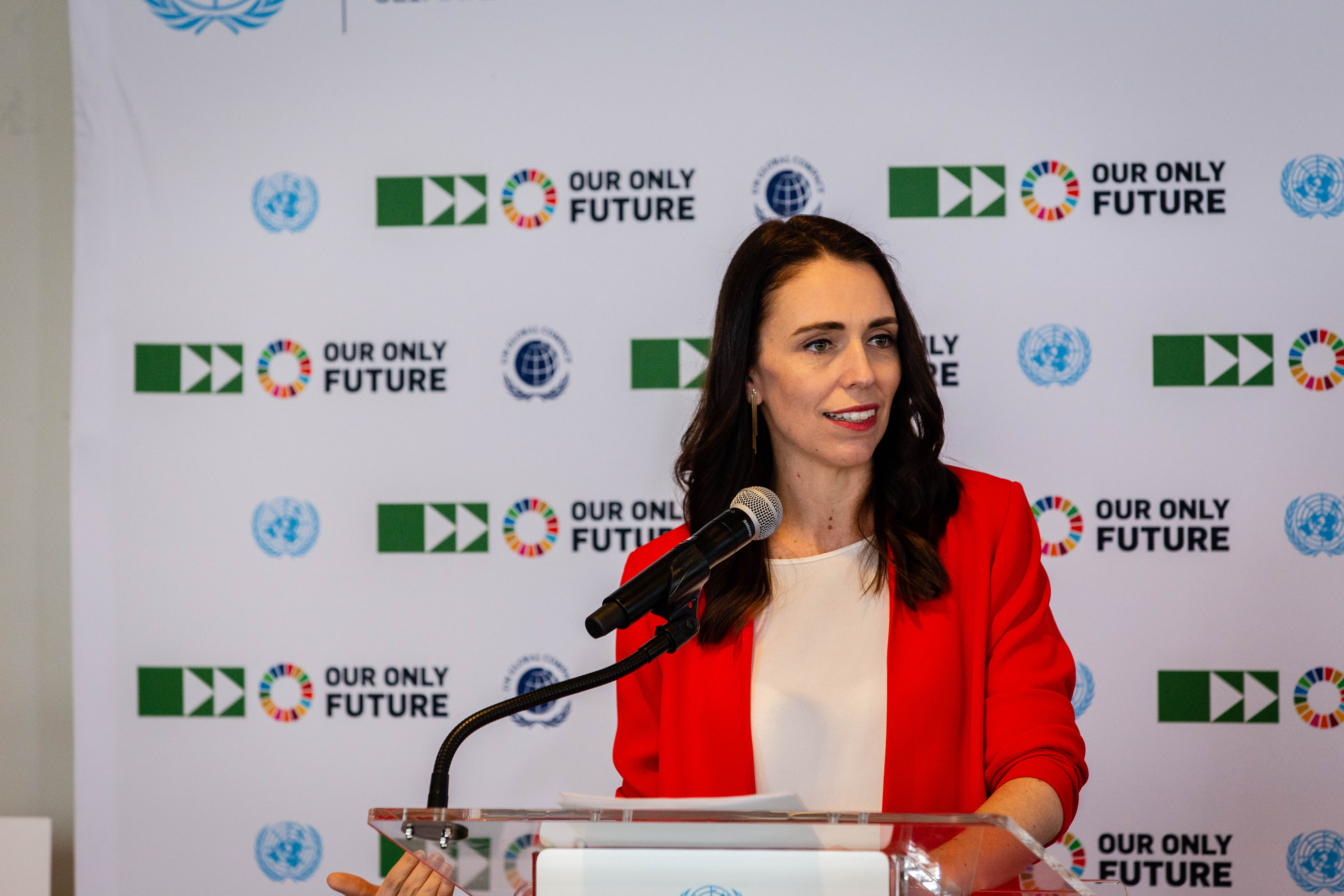
Prime Minister Jacinda Ardern of New Zealand at the Private Sector Forum 2019.
Photo credit: UN Global Compact/Joel Sheakoski
In her special remarks, Prime Minister of New Zealand Jacinda Ardern articulated the importance of optimism when it comes to the climate challenge, saying: “If we only talk about the loss of glacier mass or about sea level rises, we run the risk of a society and a generation that believes all is lost and that it is simply too late. It is not. No one has the luxury of copping out — not those who deny climate change nor those who believe it’s too far gone. Now is the time for optimism and for hope — but crucially that must be coupled with a plan.”
“Having a network of business leaders that are committed to science-based targets in line with the Paris Agreement creates incredible leverage and the opportunity to apply international best practice to dramatically reduce their emissions,” Prime Minister Ardern added. “Ultimately if we treat the transition to a low-carbon economy as an investment — as an opportunity — then we can and should expect a return on that investment above and beyond merely staving off a crisis.”
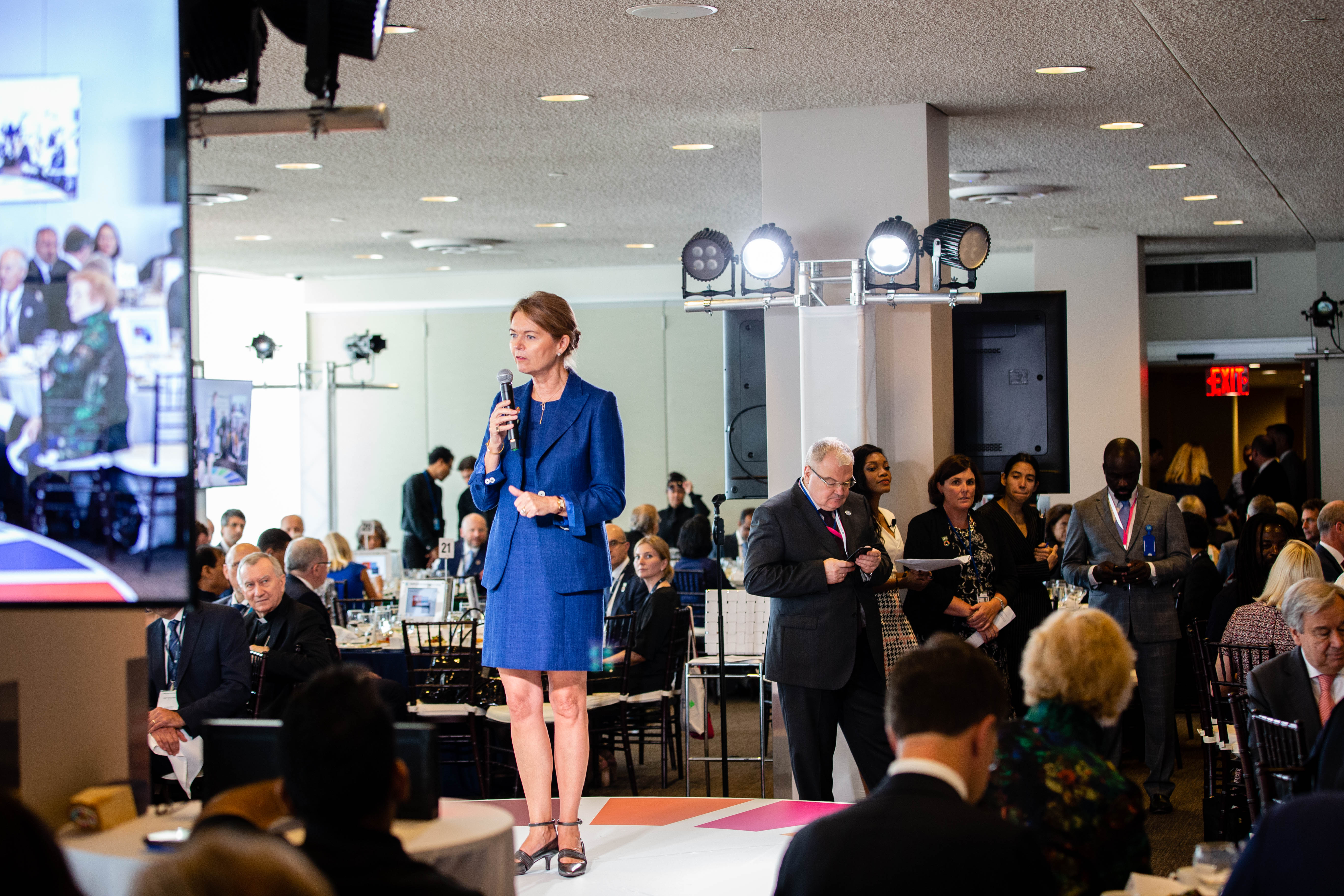
UN Global Compact CEO & Executive Director Lise Kingo at the Private Sector Forum 2019.
Photo credit: UN Global Compact/Joel Sheakoski
Addressing the global leaders in attendance, Lise Kingo, CEO and Executive Director of the UN Global Compact, said, “At the UN Global Compact — with our friends from the UN and all our friends from the business community — we have launched a very ambitious campaign where we are asking companies across the world to adopt a 1.5˚C science-based target. Today, we have 87 companies that have taken this hugely innovative, strong leadership commitment.”
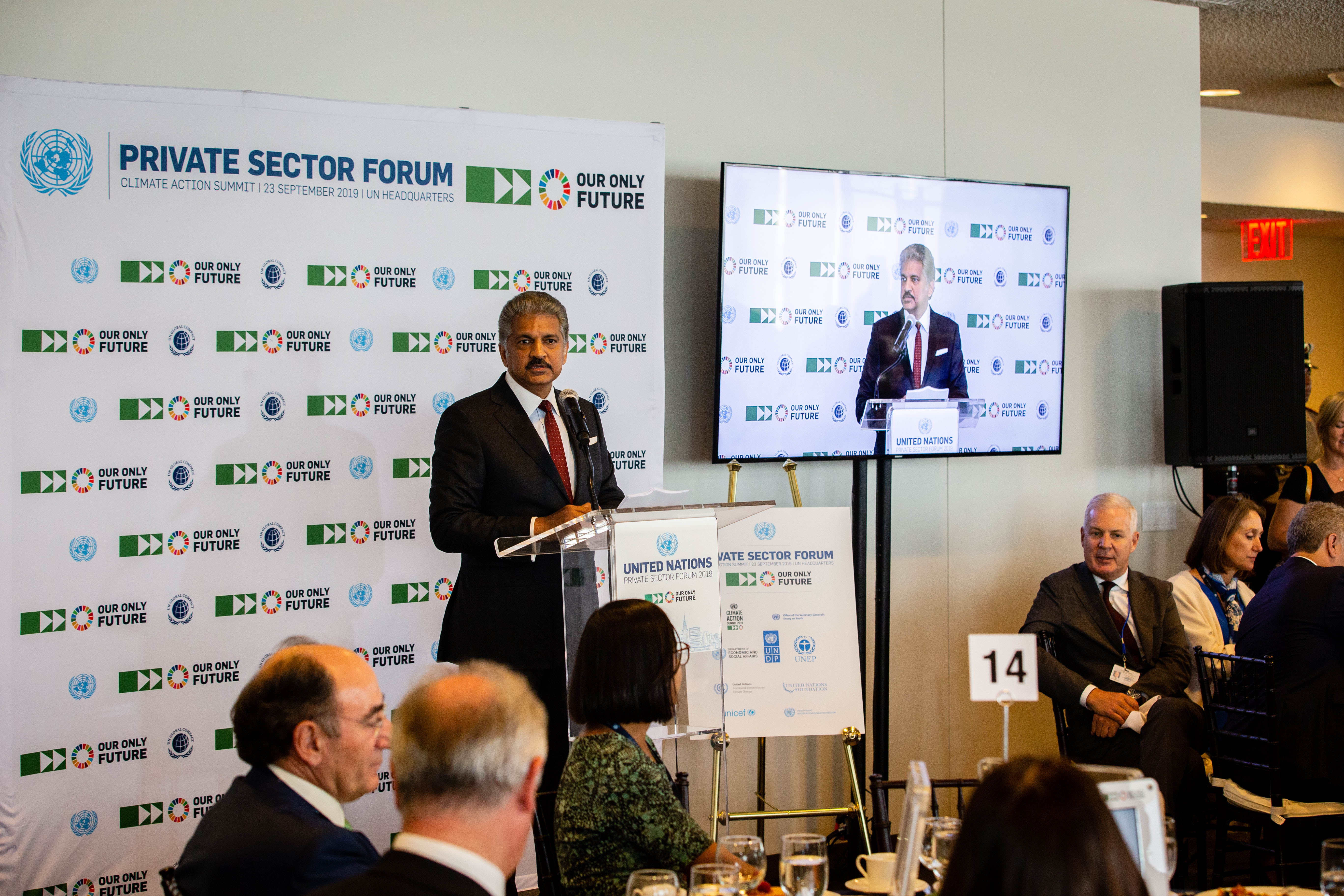
Mr. Anand Mahindra, UN Global Compact Board Member and Chairman of Mahindra Group, at the Private Sector Forum 2019.
Photo credit: UN Global Compact/Joel Sheakoski
Speaking on behalf of the business community, Anand Mahindra, UN Global Compact Board Member and Chairman of Mahindra Group — an Indian multinational conglomerate — emphasized the business transformation that is already underway, noting that “the reason that most businesses are going to change is because we are going to ditch an old dichotomy — because it is not sustainability or profit, it is sustainability with profit.”
“I have been voicing one message with monotonous regularity and that is that climate change is not just a trade-off, but it is also the biggest business opportunity of the next decades,” he added.
The event also featured innovation pitches from young climate entrepreneurs, as well as a live polling and dialogue segment with all participants, challenging them to reflect on some of the toughest questions we face in limiting the worst impacts of climate change.
Before the Forum, the UN Global Compact hosted a Transformative Business Leadership for a 1.5˚C Future session, convening business executives to discuss the future of ambitious corporate climate leadership to achieve the 2030 Agenda for Sustainable Development and the targets of the Paris Agreement.
The session featured the launch of the Business Leadership for 1.5°C report — produced by the UN Global Compact, DNV GL and Sustainia — featuring practical solutions and strategies developed by companies participating in the Business Ambition for 1.5˚C — Our Only Future campaign. It also included a panel with Chief Executives who were interviewed for the UN Global Compact-Accenture Strategy 2019 CEO Study.
Also at UN Headquarters today, the UN Global Compact convened the Sustainable Ocean Business side event featuring the launch of Sustainable Ocean Principles developed by the Action Platform on Sustainable Ocean Business in consultation with more than 300 stakeholders worldwide. Connecting to the broader themes of the Climate Action Summit, speakers emphasized the responsibility of businesses to take necessary measures to secure a healthy and productive ocean.
In parallel with the UN High-Level Meeting on Universal Health Coverage, the Health is Everyone's Business event in the afternoon showcased the interlinkages between public health and climate, emphasizing that business action that targets co-benefits for the health of people and the planet is necessary for achieving a healthy future for all. The event also featured the launch of the Business Leadership Brief for Healthy People, Healthy Planet.
The day closed out with a Climate Action Reception, featuring Global Compact LEAD companies and the 2019 class of young UN Global Compact SDG Pioneers, while also reflecting back conversations had throughout the day.
-
Watch a recap video from the event
-
Read more about the Private Sector Forum 2019
-
Discover the 87 companies leading the way in 1.5˚C science-based target setting, and take action for our only future
-
Learn more about all events taking place during UN Global Compact Leaders Week
###
About the United Nations Global Compact
As a special initiative of the UN Secretary-General, the United Nations Global Compact works with companies everywhere to align their operations and strategies with ten universal principles in the areas of human rights, labour, environment and anti-corruption. Launched in 2000, the UN Global Compact guides and supports the global business community in advancing UN goals and values through responsible corporate practices. With more than 9,500 companies and 3,000 non-business signatories based in over 160 countries, and more than 60 Local Networks, it is the world’s largest corporate sustainability initiative.
For more information, follow @globalcompact and visit unglobalcompact.org.
Contact
UN Global Compact
Communications Team
Email: media@unglobalcompact.org